

With the UK experiencing four heatwaves so far this year and heat-health warnings in place across parts of England, Vent-Axia has sponsored a new white paper examining the growing challenge of overheating in UK buildings.
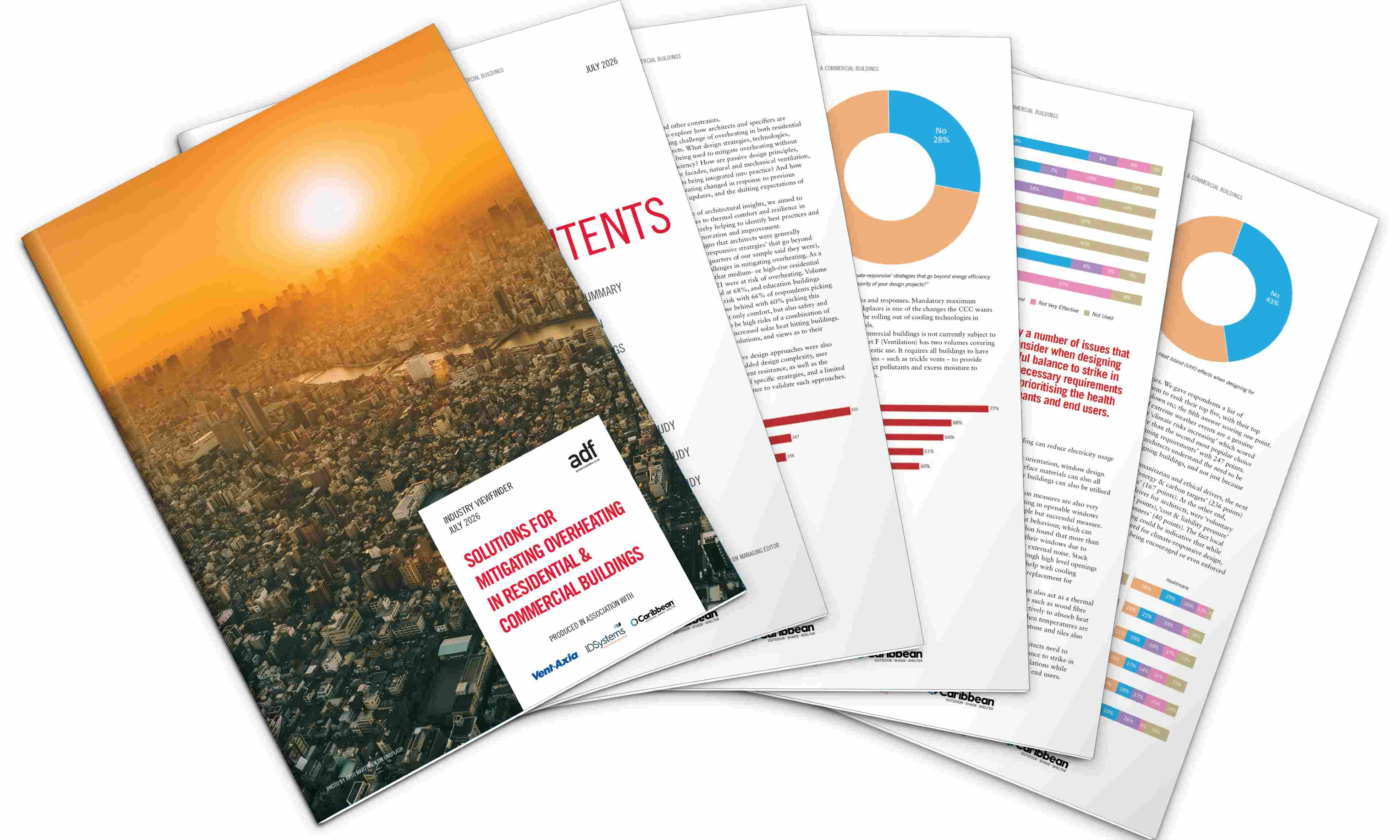
Published by Architects Datafile (ADF), Solutions for Mitigating Overheating in Residential and Commercial Buildings explores how architects are responding to the need to mitigate overheating in new-build properties amid tightening regulations and rising temperatures, including the increasing role of ventilation as part of the overall mitigation strategy.
With more than 2,800 excess deaths estimated during the May and June 2026 heatwaves, and the impact of July’s heatwaves yet to be assessed, overheating in buildings has become a serious public health issue. Three-quarters of those surveyed in the white paper were actively considering climate-responsive strategies that go beyond regulatory minimums when designing buildings.
There are, however, a range of challenges in mitigating overheating. As new buildings become more thermally efficient to reduce carbon emissions and help meet the UK’s Net Zero 2050 target, the risk of overheating is increasing.
Some 77% of respondents believed that medium or high-rise residential buildings designed to Part L 2021 were at risk of overheating, with volume housebuilding not far behind at 68%. Education buildings were considered the third highest risk, with 66% of those surveyed identifying them as vulnerable to overheating.
When removing excess heat, Approved Document O of the Building Regulations 2021 prioritises passive measures to reduce overheating. However, the findings suggest effective mechanical ventilation is becoming an increasingly important part of the overall strategy, particularly where passive design alone cannot adequately remove excess heat.
Some 69% of respondents cited Mechanical Ventilation with Heat Recovery (MVHR) as the ventilation approach they use most frequently. In addition, almost six in 10 (59%) believe the Future Homes Standard will accelerate demand for intelligent ventilation systems capable of automatically responding to changing indoor and outdoor temperatures.
“In the recent heatwaves, we have all experienced how overheating is becoming a challenge in our homes. With homes becoming more airtight to reduce carbon emissions, while global temperatures continue to rise, this challenge is only set to increase. As a result, architects are finding it more difficult to achieve the requirements set out to combat the overheating risk in Part O and TM59 standards,” said Steve Pearce, Product Manager at Vent-Axia.
“In line with Part O, passive design should always be considered first. However, where these measures alone cannot adequately mitigate overheating, effective ventilation has an important role to play in helping remove excess heat, improve indoor air quality and create healthier, more comfortable buildings.
“As the research shows, architects are increasingly recognising the importance of effective mechanical ventilation strategies in their buildings, with MVHR frequently the mechanical ventilation of choice in new-build properties.”
When removing excess heat, Part O lists acceptable methods in order of preference, starting with opening windows, followed by ventilation louvres, mechanical ventilation and finally mechanical cooling. When natural ventilation options are restricted, mechanical ventilation can provide an alternative solution.
With today’s developments demanding flexibility to meet building regulations while providing good thermal comfort and indoor air quality, there is no longer a one-size-fits-all approach to ventilation. Instead, a range of adaptable solutions may be required to meet project-specific requirements.
Download the Solutions for Mitigating Overheating in Residential and Commercial Buildings white paper from Vent-Axia.